
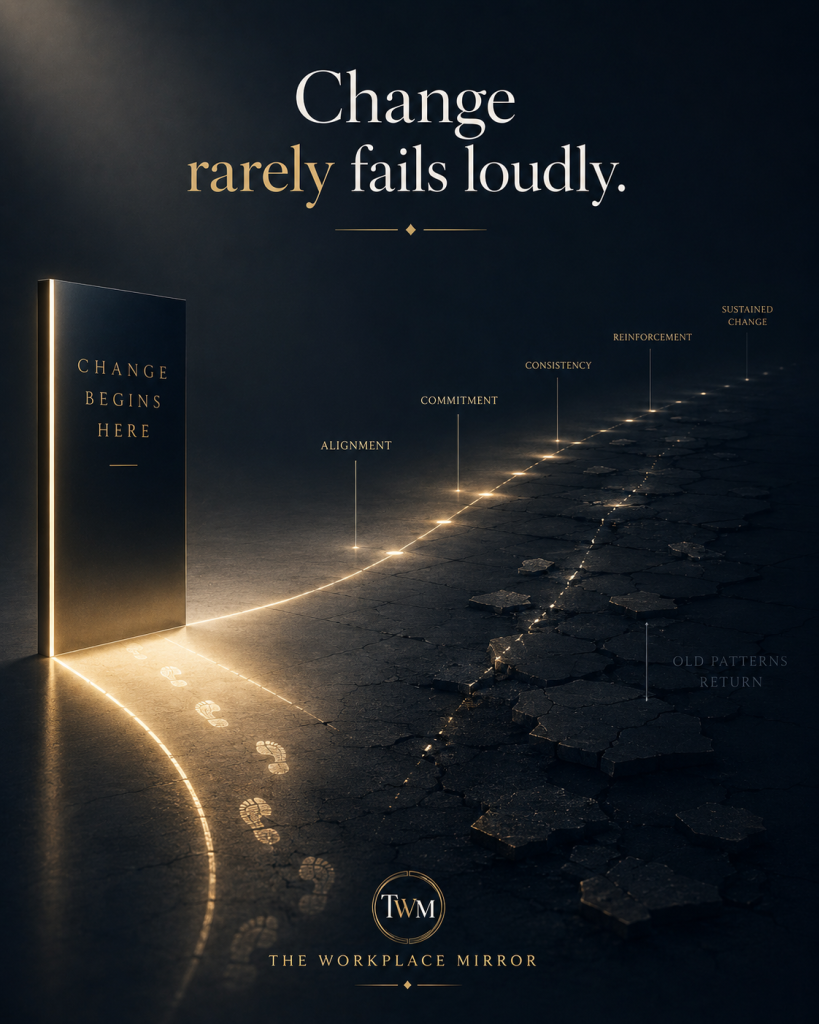
Most organisational change does not collapse overnight.
It fades.
Quietly.
One inconsistency at a time.
An organisation announces a new direction. Leaders speak about accountability, communication, trust, culture, performance, or change. Workshops are held. Meetings take place. New expectations are introduced. For a while, energy rises and optimism follows.
Then slowly, almost invisibly, old patterns begin returning.
The difficult conversation that should have happened is avoided. Accountability softens under pressure. Leaders stop reinforcing what was announced. Managers revert to urgency instead of consistency. Employees begin noticing that what was said and what is being tolerated are no longer aligned.
And eventually, people conclude what they have concluded many times before:
“This will pass.”
That is one of the reasons organisational change so often fails quietly rather than dramatically.
Many organisations think change fails because employees resist it. Sometimes that is true. But in many cases, the deeper issue is not resistance. It is inconsistency.
People watch leadership behaviour more carefully than leadership messaging.
An organisation may announce that accountability matters, but if underperformance continues without consequence, employees learn the real lesson quickly. A company may say it values openness, but if employees see difficult truths ignored or punished, silence becomes the safer strategy. Leaders may call for collaboration while continuing to reward silo behaviour and internal competition.
Over time, employees stop responding to what leadership says and start responding to what leadership normalises.
This is why sustainable organisational change is difficult. It is not only about strategy, communication, or good intentions. It is about reinforcement.
Organisations naturally drift back toward what has historically been rewarded, tolerated, protected, or ignored. Under pressure, people often return to familiar behaviours unless leaders consistently reinforce the new direction through decisions, accountability, visibility, and follow-through.
The real test of organisational change is therefore not what happens during launch week.
It is what happens three months later.
What happens when operational pressure rises again? What happens when difficult conversations become uncomfortable? What happens when the excitement fades and consistency becomes harder than inspiration?
That is where organisations discover whether change was truly embedded or whether it was simply announced.
This is one of the reasons I developed The Workplace Mirror as more than a body of leadership reflections and organisational commentary. Sustainable organisational improvement requires more than identifying problems. It requires clarity, response, reinforcement, and the willingness to examine what organisations repeatedly allow themselves to drift back toward.
Because culture does not ultimately follow speeches.
It follows behaviour.
And people rarely believe change because it was announced.
They believe it when leadership continues to reinforce it long after the launch meeting has ended.