
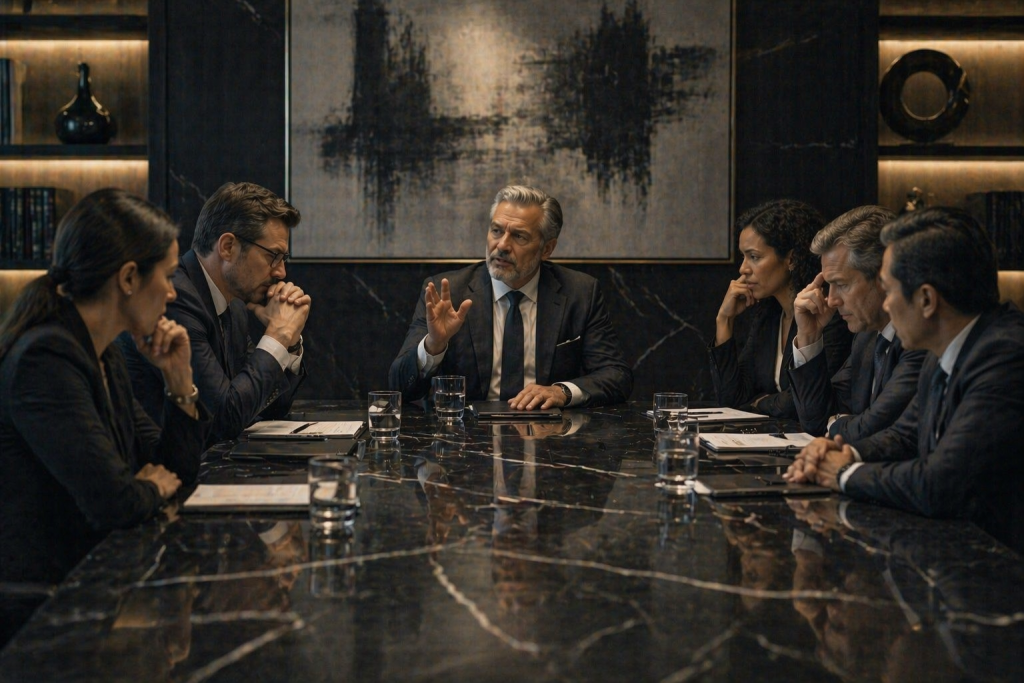
Have you ever been in a meeting where a leader hinted at a decision you knew was unwise?
You raised your concern privately beforehand. A colleague agreed. Perhaps the two of you even discussed speaking up together so the leader might pause and reconsider. Then the meeting began. You spoke. They froze. The leader asked if anyone else felt the same way. The room went silent. And in that silence, the decision moved forward, not because everyone agreed, but because almost no one challenged it.
That pattern does not belong only to politics, war rooms, or global headlines. It belongs to boardrooms, executive teams, and organizations everywhere.
The leadership issue is simple and serious: voice matters most when momentum is building.
When a persuasive voice enters early, frames the issue with urgency, and begins to pull the room in one direction, something subtle can happen. The room adjusts. Questions soften. Dissent becomes cautious. Silence begins to look like alignment, even when it is not.
This is why psychological safety matters so deeply in high-stakes decision-making. Psychological safety is not comfort. It is not lower standards. It is not the removal of accountability. It is the shared belief that people can raise concerns, challenge assumptions, and test an emerging decision without punishment, humiliation, or quiet exile. Without it, leadership teams may still look polished and functional, but the quality of challenge begins to collapse.
The meeting still happens. The papers are circulated. The formal approvals are recorded. Governance structures appear intact. But once challenge collapses, influence expands.
And that is one of the most dangerous moments in leadership.
The people pressing hardest for action are not always the people with the best judgment. Sometimes they are the people with the strongest agenda, the greatest access, or the clearest personal stake. The real question, then, is not simply whether a process was followed. It is whether the process still had enough spine to test the decision before it hardened into action.
Strong leaders understand this. They do not build rooms full of polite agreement. They build rooms where serious challenge can survive proximity to power. They know that both the leader and the organization have the most to lose when poor decisions go unchallenged and ego goes unchecked.
When challenge weakens, the consequences are familiar. Bad decisions move too quickly. Risks are underexamined. Accountability softens. Credibility erodes. And when people do not feel safe speaking in the room, voice does not disappear. It relocates.
Sometimes into corridors.
Sometimes into leaks.
Sometimes into resignation.
Silence is not always approval. Sometimes it is caution. Sometimes it is fear. Sometimes it is the sound of a room that has learned that truth is expensive.
This is why boards, founders, and executive teams need to ask harder questions before decisions become irreversible:
Who in this room still feels safe enough to challenge me?
What happens to the person who does?
Are we testing this decision, or merely formalising it?
Do our governance structures still have courage, or only procedure?
These are not small questions. They are safeguards against preventable failure.
At the end of the day, the issue is not whether a leader can command a room. It is whether the room still has the courage to speak.
Because once challenge weakens, influence fills the space.
And when that happens, the leader may still hold authority, but the organization has already begun to lose one of its greatest protections:
the truth spoken in time.